The Ingredient-List Shortcut That Tells You Too Little
An ingredient list tells you what a formula contains, not what it will do. Read claims, directions and cautions together to judge the product more clearly.
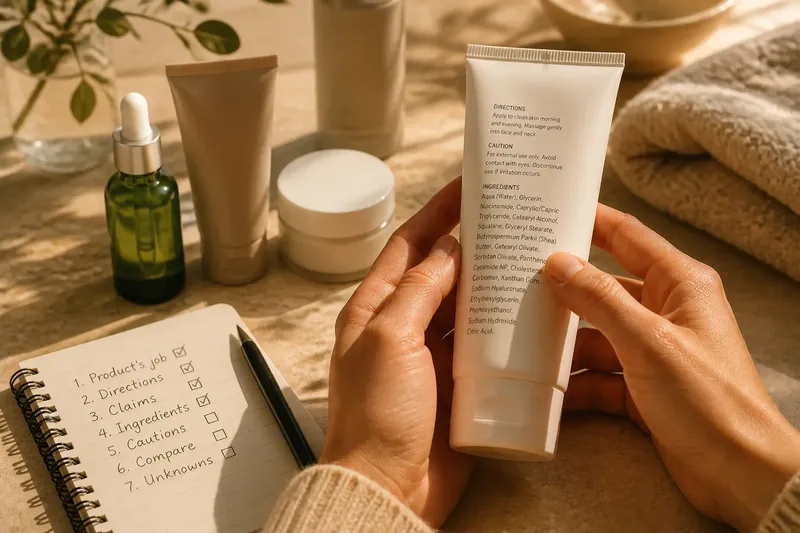
Does an ingredient list tell you whether a skincare product will suit you? The ingredient-list shortcut—spot a familiar name, then infer the result—leaves out the formula, the directions and the claims printed elsewhere on the pack.
Read the label in a deliberate order, but there is no need to spread the task over a week. The sequence is simply a way to keep one recognisable ingredient from doing the work of the whole label.
Start with the product’s stated job
Read the front and back panels before searching the ingredient list for a favourite. Is this a cleanser, moisturiser, serum or sunscreen? What does the maker say it is intended to do: remove makeup, soften dry-feeling skin, add hydration or protect against sun exposure? Those details set the context for the formula.
Then distinguish a product description from a promise. “With ceramides” names an ingredient. “For dry skin” describes an intended audience. A claim about visible results is a stronger statement, but the ingredient list alone cannot confirm how well that claim applies to a particular person. The label tells you what the maker presents; it does not predict your individual response.
Pay attention to the product’s form, too. Glycerin in a rinse-off cleanser appears in a different context from glycerin in a moisturiser left on the skin. The name is the same; the product’s job and directions are not. An ingredient name is like one item in a recipe, not the finished dish.
Read the ingredient list in a sensible order
Rather than assigning a day to each task, move through the label in one sitting or return to it when a specific question arises. The order below is a reading sequence, not a waiting period.
- Identify the category. Check whether the product is rinsed off or left on, and whether it is for the face, body or another area. If the category is unclear, do not infer it from the featured ingredient; check the directions or product information instead.
- Read the directions. Look for where, how and when the product is meant to be used. If the directions specify a particular application method or area to avoid, follow them; if they are unclear, check the manufacturer’s information before use.
- Read the claims in full. Separate the named ingredient from the stated benefit. If the pack says only “contains salicylic acid”, treat that as an ingredient statement, not a claim that the product treats a condition.
- Inspect the full ingredient list. Find the ingredient you were curious about, then read the surrounding names. If you are checking for a known allergen, compare the exact listed name with reliable advice; if the name is ambiguous, ask the manufacturer or a qualified professional rather than guessing.
- Check cautions and practical limits. Read warnings and storage directions. If a caution conflicts with your intended use, do not proceed on the strength of a familiar ingredient name; seek clarification or choose another product.
- Compare like with like. Compare products with similar purposes and use patterns. If both are leave-on facial moisturisers, their labels can be compared on that basis; if one is a rinse-off cleanser, treat the difference in use as a reason not to compare them as direct substitutes.
- Mark what remains unknown. If the label does not answer your question, check the manufacturer’s product information or consult a qualified professional where appropriate. If the information is still absent, record that it is not stated instead of filling the gap with an assumption.
Say you are choosing between two products and the hypothetical starting information is this: both mention niacinamide, but one is labelled as a face moisturiser with daily leave-on directions, while the other is a body lotion. First, compare their stated areas: they differ. Next, compare their directions: one is for facial leave-on use, while the other is labelled for the body. Then check each full ingredient list and cautions against your own needs. The resulting decision is limited but useful: if you want a facial moisturiser, the first fits that stated purpose more closely; the labels alone do not establish which will suit your skin better.
Read the ingredient list as a formula, not a promise
Ingredient lists can help you check whether a particular substance appears in a product, and may help you avoid something you already know you do not tolerate. They do not, by themselves, explain the concentration, how ingredients are combined or how the finished product will feel on your skin. Do not reverse-engineer a formula from list order or treat a long list as proof of strength.
Names can also be less familiar than the marketing language on the front panel. A botanical name, a common name and a name used for a derivative may not look alike to a casual reader. If the label does not make the relationship clear, check the manufacturer’s ingredient explanation rather than deciding that unfamiliar wording means the ingredient is absent or present in a more potent form.
An ingredient may contribute to texture, help support the formula or be included for a stated skin-care purpose. The list tells you that it is there; the surrounding label gives clues about why the product is being sold and how it is meant to be used. Those clues are still not a personal forecast.
Notice where the label puts the emphasis
Front-panel language is designed to be quickly understood. It may feature one ingredient, while the back panel carries directions, warnings and fuller formula information. Neither panel is automatically more truthful; they answer different questions. The front gives the product’s pitch, while the rest of the package supplies detail needed to judge that pitch.
Watch for the difference between a named ingredient and a named benefit. A product can highlight an ingredient without promising a particular outcome. Conversely, a benefit claim may appear without explaining how the ingredient list relates to it. If the wording feels vague, write down the question it leaves open: Is this rinse-off or leave-on? Is it intended for my face? Is there a caution relevant to my use?
Claims about sensitive skin, fragrance or suitability deserve the same careful reading. A reassuring phrase does not establish that every person will tolerate a product, and the absence of one ingredient does not make a formula universally suitable. If you have a known allergy, a persistent skin concern or a reaction to a product, a qualified health professional is a better source of individual advice than a slogan.
What can the ingredient label answer?
Can the ingredient list tell me the concentration?
Not usually from the list alone. Ingredient order and local labelling rules can offer context, but they are not a reliable substitute for a clear concentration statement from the manufacturer.
Does a familiar ingredient name mean the product will suit me?
No. Suitability depends on the whole formula, how you use it and your own skin. A familiar name is a reason to read further, not a personal recommendation.
Should I avoid an ingredient I cannot pronounce?
Pronunciation is not a measure of risk. Look up the exact name through the manufacturer or a reliable professional source, especially if you are checking for a known allergy or sensitivity.
What if the label and product page use different wording?
Compare the directions, claims and ingredient information rather than relying on a short headline. Where the difference affects safe or appropriate use, ask the manufacturer or a qualified professional before deciding.
Make the decision from the whole label
Before buying or using a product, check that its intended area and format fit your routine, that the directions are workable, and that no listed caution conflicts with your needs. If an answer depends on the label, manufacturer instructions or local rules, follow those rather than general assumptions.
For the ingredient-list shortcut, treat a name as a prompt, then read outward: product purpose, directions, claims, cautions and the full formula. The useful result is not a prediction, but a clearer distinction between what the package says, what it leaves unstated and what you still need to decide.